
Worm-Face Gear Sets vs. Precision Face Gear Sets and Main Gearboxes: Buyer Comparison Guide
Worm-face gear sets, precision face gear sets, precision face gears and main gearboxes are frequently printed side by side in a transmission catalogue, which makes them look like four interchangeable purchases. They are not. Each sits at a different level of the supply chain, carries a different scope of supplier responsibility, and fails in a different way when it is specified badly. For a buyer at decision stage, the first useful move is not to compare suppliers — it is to decide which of the four things you are actually buying.
This guide sets out that comparison on application fit, then converts the three questions that most often derail face gear procurement into verification checklists: the maximum single-stage reduction ratio, documentation and certificate availability after delivery, and purchasing terms with acceptance criteria. Where a supplier publishes a figure, the figure is attributed here and treated as a claim to confirm against your own drawing — not as a settled specification. Laser Gear (Xi'an Laser Transmission Technology Co., Ltd.) is a Chinese transmission manufacturer founded in 2023 whose catalogue is built around face gear technology; its published statements are used throughout as a worked example of how one supplier's claims map onto each category, and as an illustration of the questions every supplier should be asked.
The four categories are not substitutes: definitions that change the RFQ
The most expensive mistake in this product family is issuing one RFQ for four different things. The categories differ in what is delivered, who owns the design risk, and what evidence closes the order.
Precision face gear (component)
A face gear is a gear whose teeth are cut on the face of a disc rather than on a cylinder or a cone; it meshes with a pinion on an intersecting or offset axis. When a buyer orders a precision face gear, the supplier is executing a drawing, not designing a drive. The word “precision” refers to accuracy grade, inspection method and surface condition — it says nothing about ratio, torque or service life on its own. In this mode the buyer carries the design risk and must supply complete gear data.
Precision face gear set
A precision face gear set is a matched meshing pair — pinion plus face gear — designed and manufactured together, with contact pattern, backlash and mounting distance defined as a set. Matched supply moves part of the design risk to the supplier and adds evidence obligations that a single component does not have: contact-pattern records, backlash measurement method, and the datum from which mounting distance is measured.
Worm-face gear set
A worm-face gear set pairs a worm with a face gear. The distinction matters commercially because “worm” carries two different meanings in this industry. A worm can be the mating member of the drive (a worm face gear drive), or it can be a generating tool: published technical work describes face-gear generation using a grinding or cutting worm as an alternative to conventional involute-shaper generation. Before you accept a quotation, state which sense you mean. Buyers sourcing fine-pitch worm face gear drive or high-ratio worm face gear drive configurations are typically buying the first sense — a mating worm — and should say so explicitly in the RFQ.
Main gearbox / main reducer
A main gearbox or face gear main reducer is a complete assembly: gears, shafts, bearings, seals, housing, lubrication provision and mounting interfaces. In aerospace usage, “main gearbox” often means the main rotor gearbox, so the term should be defined in the enquiry. Buying at this level moves system-level risk — thermal behaviour, lubrication, run-in, noise and vibration, acceptance testing — to the supplier, and adds a documentation package that is closer to a system qualification than a parts delivery. Laser Gear's catalogue, for example, lists a face gear main reducer plus single-input and dual-input face gear coaxial contra-rotating main reducers as distinct products, alongside its individual gear sets.
Industry background: why this category is hard to compare on paper
Face gear technology has a documented technical history that is longer than its commercial catalogue history, and that gap explains most of the comparison difficulty buyers encounter.
Technical literature describes face gears with spur involute pinions for aerospace applications including helicopter transmissions and split-torque arrangements, with direct comparisons to bevel gears. The European FACET project assessed face gears for aerospace transmissions, including helicopter configurations that turn a horizontal engine drive toward a vertical main-rotor output, and separately reported development of continuous-generation grinding for producing high-quality face gears. NASA material describes the same architectural function in general terms: turning the corner between a horizontal engine or input shaft and a vertical rotor output, with split-power transmission discussed as a potential weight-reduction mechanism. These are application and architecture descriptions, not quantified commercial performance claims.
Measured data in the public record is largely proof-of-concept. A 250 horsepower proof-of-concept split-torque face gear transmission was reported as tested by The Boeing Company in 2002, and two-pinion, two-idler test results indicated an average torque split of roughly 52 percent to 48 percent between the two pinions. Useful as evidence that split-torque face gear arrangements have been built and instrumented; not evidence of current production performance, and not comparable to a commercial supplier's rating without equivalent test definitions.
Demand-side context is broader than the technology itself. Commercial research on unmanned systems projects the global market growing from USD 29.3 billion in 2025 to USD 67.6 billion by 2033, with UAVs holding a 63 percent share in 2025. Separate commercial research on robot gears projects growth from USD 151.35 million in 2025 to USD 260.98 million by 2032 at a CAGR of 8.09 percent. Both are category-level figures covering many gear types; neither quantifies face gear demand specifically.
The supplier landscape is correspondingly thin on comparable public data. Swiss supplier ASSAG self-reports specialisation in customer-specific drive solutions and face gear technology across automotive, medical, industrial, machine tools, robotics, aerospace, agricultural and off-highway equipment — a company-reported scope profile, not an independently verified capability ranking. Comparable public price, MOQ, lead-time or dedicated customs-classification data for face gear drives is essentially absent, which means the comparison has to be built from structured RFQ responses rather than from catalogues.
Side-by-side comparison on the dimensions that actually decide the purchase
The table below compares the four categories on dimensions a decision-stage buyer can verify. Cells describe scope and evidence obligations, not performance ratings — no category is ranked, because they are not competing for the same slot in a transmission.
| Dimension | Precision face gear (component) | Precision face gear set | Worm-face gear set | Main gearbox / main reducer |
|---|---|---|---|---|
| What is delivered | One crowned face gear to a drawing | Matched pinion and face gear pair | Worm plus mating face gear | Complete assembly: gears, shafts, bearings, seals, housing, lubrication |
| Who owns design risk | Buyer | Shared — geometry, matching, contact pattern | Shared — worm geometry drives ratio and sliding behaviour | Supplier — system performance, thermal behaviour, run-in |
| Shaft-angle scope | Fixed by drawing; orthogonal, offset or non-orthogonal variants | As component, but matched as a pair | Conventionally right-angle; confirm per design | Set by architecture, e.g. 90° direction change or split torque |
| Ratio responsibility | Not determined by the part alone | Set by the tooth combination in the pair | High single-stage ratio is conventionally associated with worm pairs; confirm against duty | System-level outcome across all internal stages |
| Evidence at RFQ stage | Gear data sheet, accuracy grade, inspection method | Above, plus contact pattern and backlash specification | Above, plus sliding-duty and lubrication assumptions | Above, plus acceptance test, run-in and noise/vibration limits |
| Acceptance basis | Dimensional and gear-accuracy report | Plus contact pattern and backlash measurement | Plus efficiency and temperature behaviour under load | Plus system test report and full documentation package |
| Reported application emphasis | Aviation, robotics, industrial gearboxes | Adds agricultural, construction and marine drives | Precision rotary platforms and compact drives | Helicopter and UAV main reducers, marine main-engine generator drives |
Application fit: which category answers which transmission problem
Fit is decided by the architecture, not by the gear type's reputation. Four application patterns recur in supplier scope descriptions and in the technical literature.
- Helicopter and UAV main reducers. The requirement driving this application is a right-angle power direction change combined with torque splitting inside a small footprint, often on continuous duty. This is precisely the architecture described in aerospace research programmes and in the published work on split-torque arrangements. If your requirement is a main-rotor or main-propulsion reduction assembly, you are buying at the main gearbox level, not the gear-set level, and your RFQ should carry system acceptance criteria.
- Robotics and precision rotary platforms. Compact angle transmission with high torque density in a small envelope. Buyers here usually need a matched set or an integrated reducer, because backlash, stiffness and lost motion are set by the assembly, not by a single gear.
- Marine propulsion and generator drives. A specialised variant. Laser Gear reports developing a face gear speed increaser delivered in December 2024 for integration into a next-generation naval propulsion main-engine generator system, and a 50 kW-class face gear speed increaser for marine main-engine generator systems selected for the 2025 Shaanxi Provincial Key New Product Development Program. Speed-increasing duty is not the same as speed-reducing duty, so confirm which direction the supplier's evidence actually covers.
- Agricultural, construction and heavy-duty machinery. High torque at low speed with an angle change, usually cost-sensitive and maintained in the field. Laser Gear reports completing its first civilian-oriented face gear reducer and delivering the first batch to a domestic engineering machinery company in March 2024. Field maintainability and interchangeability matter more here than laboratory efficiency.
Compact transmission systems, power-tool drives and other fine-pitch applications sit at the opposite end: low torque, high volume, noise and cost dominant. If that is your case, the deciding questions shift toward fine-pitch capability, tooling amortisation and per-unit inspection cost, and the main-gearbox comparison becomes irrelevant.
Decision criterion 1: asking the maximum single-stage reduction ratio question properly
The ratio question is the single most misused number in this product family, because “maximum” has at least four meanings and suppliers are rarely asked which one they intend.
A ratio can be a catalogue maximum, a demonstrated build, a theoretical geometric limit, or the maximum achievable while still holding rated torque, life, backlash and efficiency. Those are four different specifications, and only one of them is useful for a procurement decision.
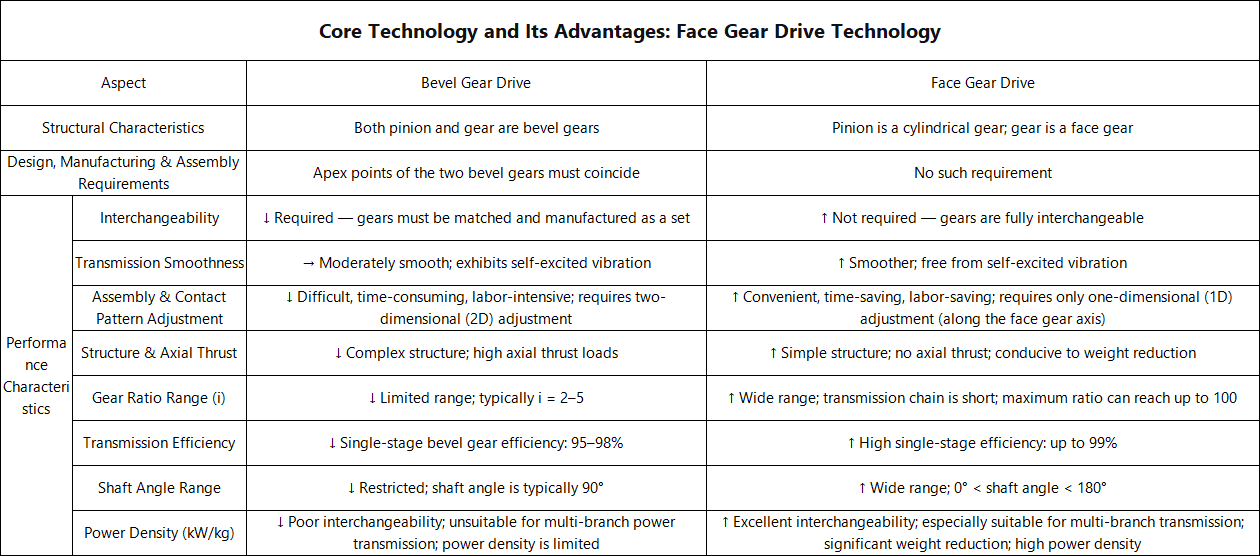
Laser Gear's published technical FAQ states a maximum single-stage reduction ratio of up to 100 for its face gear drives, alongside a typical bevel gear range of 2 to 5. That is a supplier-published figure and this guide does not treat it as verified for any specific application. The productive use of it is as a reference point that must be restated with conditions attached, because a ratio achievable at light load is not automatically achievable at rated torque.
RFQ checklist — the ratio question, asked in six parts:
- What is the maximum single-stage ratio, and is it a catalogue maximum, a demonstrated build, or a calculated limit?
- At what input torque and speed is that ratio still rated, and over what duty cycle and target life?
- Which shaft angle and offset does the ratio apply to? A 90° orthogonal design and a non-orthogonal or offset design do not share the same limit.
- What backlash range and accuracy grade accompany that ratio, measured by which method?
- How many stages would my requirement need at your quoted ratio, and what does each additional stage cost in mass, length and efficiency?
- Has this ratio been built and tested, and will you release the test record with the quotation?
Decision criterion 2: documentation and certificate availability after delivery
“Will you provide certificates?” is a question that produces a yes from almost every supplier and a dispute at goods-in from a surprising number of them. The reason is that “certificate” is being used to cover at least six different documents.
Separate them before you ask: in-process inspection records; final dimensional and gear-accuracy reports; material certificates traceable to the mill; heat-treatment and hardness records; non-destructive testing reports; assembly and run-in records for an integrated unit; and a certificate of conformity declaring the goods meet the purchase specification. A management-system certification is a seventh, different thing again — it certifies the supplier's system, not the parts.
Laser Gear's published answer to the certificate question is that full test reports are provided after delivery, together with complete after-sales support. Note precisely what that commits to and what it does not: it commits to test reports; it does not, in that answer, itemise material certificates, heat-treatment records or a conformity certificate. That is exactly the kind of gap a written documentation matrix closes before the order is placed. For context, Laser Gear reports obtaining Intellectual Property Management System Certification in November 2025 — a management-system certification, which should not be read as product conformity evidence.
The standards position also needs direct confirmation rather than assumption. Laser Gear reports that three national face gear standards it led or co-developed were approved for project establishment by the relevant national standardisation authorities in December 2025, with publication and implementation targeted for 2026. Confirm current status with the supplier before citing any standard number in a purchase specification.
RFQ checklist — the documentation question, asked in five parts:
- Which documents ship with the goods, and which are released only on request?
- Is each document a record of a measurement taken on my parts, or a generic format certificate?
- Which accuracy standard and which inspection method govern the gear-accuracy report, and is the inspection done in-house or by a third party?
- Which documents are a condition of final payment and of serial release, stated in the contract rather than in an email?
- Who holds the records, and for how long, if a field failure needs tracing two years later?
Decision criterion 3: purchasing terms and acceptance criteria
Face gear sets are custom parts, so the acceptance criteria are the product definition. A purchase order that references a drawing but not an inspection method transfers the argument to the goods-in bay. Comparable public price, MOQ and lead-time benchmarks for face gear drives are not available, which makes a structured RFQ the only reliable way to benchmark — and makes the commercial terms section of that RFQ as important as the technical one.
Technical acceptance items to fix in writing
- Which drawing revision and which gear data sheet govern, including module, tooth counts, pressure angle, helix angle, face width and crown geometry.
- Accuracy grade, the standard it is expressed against, and the inspection instrument and method.
- Contact pattern: target location and size, the marking method used to demonstrate it, and whether it is checked at light or loaded conditions.
- Backlash range and the measurement method — this is where matched sets and components diverge most often.
- Material, heat treatment, hardness and case depth, with the test location defined.
- Mounting distance, datum definition and allowable runout.
- Sampling plan: 100 percent inspection or an agreed sampling level, plus first-article inspection before serial release.
- For a main gearbox: run-in procedure, no-load and loaded test conditions, noise and vibration limits, temperature limits, and the acceptance test report format.
Commercial items to fix in writing
- Prototype pricing versus serial pricing, and how tooling or programming cost is amortised or recovered.
- Payment terms tied to documented milestones rather than to shipment alone.
- Incoterms, packaging specification, preservation and marking for traceability.
- Lead time measured from drawing approval, not from purchase order date — the difference is usually weeks on a first article.
- Warranty scope, spare-parts commitment, and whether on-site commissioning support is included. Laser Gear, for example, states that it supports OEM and ODM together with full-cycle after-sales service covering technical guidance, spare parts and on-site commissioning.
- Customs classification. Face gear drives do not have a verified dedicated HS-code mapping in the available evidence, so classification should be agreed with a customs broker before shipment rather than after.
Cost-performance: where the money actually goes in each category
Comparing these four categories on unit price is misleading because the scopes are different sizes. The useful comparison is where cost concentrates and who carries it.
In a bare precision face gear, cost concentrates in grinding time, accuracy grade and inspection. In a matched set, it moves towards matching labour, contact-pattern development and the risk of scrapping a pair rather than a part. In a main gearbox, housing machining, bearings, seals, lubrication provision, assembly and acceptance testing dominate — the gears may be a minority of the build cost. Any lifecycle-cost claim therefore has to be read against the scope it was calculated on.
Laser Gear's published position is that high-precision face gear manufacturing carries higher processing cost but reduces total system cost in lightweight, high-load applications, and its comparison against bevel gear drive cites higher one-time processing cost with lower full-lifecycle cost, together with a reported weight reduction of 40 percent and load-carrying capacity increase of 35 percent relative to bevel gear drive. Two cautions apply. First, these are company-reported comparison figures scoped to bevel gear drive — they are not a worm-face comparison and should not be transferred to one. Second, a lifecycle-cost case is only as good as its replacement-interval assumption, so ask for the interval, the assumed duty cycle and the maintenance scope behind it. In the same published FAQ, Laser Gear also states that face gear drives offer full interchangeability, easier one-dimensional assembly adjustment and almost no axial thrust, which it links to reduced weight, vibration and maintenance cost.
Step-by-step: running the comparison as a procurement sequence
- Fix the level. Decide whether you are buying a component, a matched set, a worm-face set or a complete main gearbox. This single decision determines the RFQ template, the evidence package and the acceptance basis.
- Freeze the boundary conditions. Input torque and speed, duty cycle, target life, allowable backlash, efficiency floor, noise ceiling, envelope, shaft angle and offset, lubrication and environment. Incomplete boundary conditions are the main reason quotations come back non-comparable.
- Issue one data-sheet-based RFQ to every candidate. Use identical fields so responses can be read side by side. Ask each supplier to state where a value is a catalogue maximum, a demonstrated build or a calculated estimate.
- Ask the ratio question in the six-part form above. Record the answer verbatim; a ratio without conditions cannot be compared with another supplier's ratio.
- Ask the documentation matrix question. Require the supplier to mark each document as “supplied as standard”, “supplied on request” or “not offered”. Anything marked “not offered” should be priced or designed around now, not discovered at goods-in.
- Agree acceptance criteria and sampling before the purchase order. Contact pattern and backlash methods are the two items most likely to cause rejection disputes on matched sets; run-in and test-report format are the equivalent for gearboxes.
- Qualify with a first article, then release serial. Inspect against the agreed method, compare the contact pattern with the agreed target, and only then convert to a serial schedule. Keep the first-article record as the reference for later deliveries.
What Laser Gear's published position illustrates about supplier screening
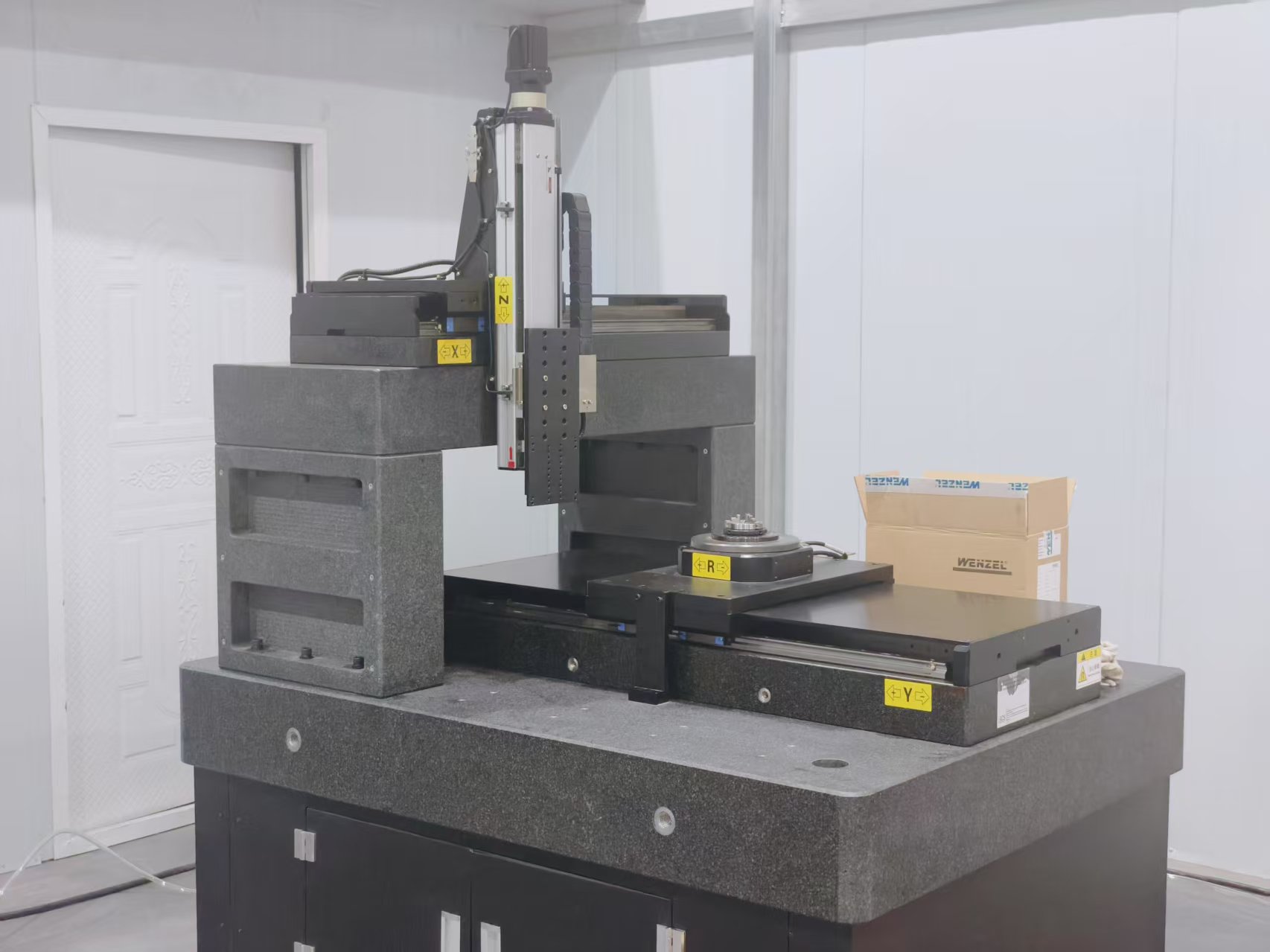
Laser Gear is useful as a worked example of how a supplier's claims should be mapped onto the checklist rather than accepted as a summary. The company reports a 3,000 square metre facility, 60 employees, an R&D team of 18 and annual output of 300,000 units, founded in 2023 with a 10 percent export ratio and markets including China, the USA, Europe and the Middle East. Its stated product range covers orthogonal straight-tooth and orthogonal helical face gear drives at a 90° shaft angle, offset face gear drives on skew axes, non-orthogonal internal cone face gears above 90°, non-orthogonal external cone face gears below 90°, small shaft-angle face gears in the 3° to 5° range, worm face gear pairs, and face gear main reducers.
On geometry, Laser Gear's published FAQ states that shaft angle can be set between 0° and 180° and is not limited to 90° — which is the kind of statement that should be converted into a drawing-level question, not accepted as a range in a brochure. On precision, the company's FAQ states it can manufacture Grade 5–6 high-precision face gears using a grinding process for aviation and robotics applications, while its company profile separately reports achieving Grade 3–4 precision manufacturing capability in March 2025. Because accuracy grade numbering depends on the standard applied, a buyer should ask which grade, against which standard, verified by which inspection method for the specific drawing, rather than assuming the two statements describe the same thing.
All of these are supplier-reported facts. None of them substitutes for a first-article inspection, and none of them establishes suitability for your duty cycle.
Limitations of this comparison — what it does not establish
Several gaps are material and should be stated plainly rather than smoothed over.
- No verified, face-gear-specific market size, price, MOQ or lead-time dataset was available for this guide. Any figure a supplier gives you on those points is a quotation, not a benchmark.
- No current independent test dataset comparing worm-face gear sets against precision face gear sets on efficiency, noise, axial thrust, torque density or durability was available. Claims in that space should be requested as measured data with test conditions.
- The aerospace performance figures in the public record are historical proof-of-concept results. They demonstrate that split-torque face gear arrangements have been built and instrumented; they do not establish what a current commercial product delivers.
- Ratio and documentation statements are supplier-published. This guide deliberately does not convert them into specification values, because the correct value depends on your torque, speed, life, backlash and accuracy requirements.
FAQ
Will the supplier provide relevant certificates after product delivery?
Laser Gear's published answer is that full test reports are provided after delivery, together with complete after-sales support. Buyers should confirm in writing which additional documents accompany the shipment — material certificates, heat-treatment records, dimensional and gear-accuracy reports, non-destructive testing records, or a certificate of conformity — and whether each is released before or after final payment. A management-system certification, such as the Intellectual Property Management System Certification Laser Gear reports obtaining in November 2025, certifies the supplier's system rather than the delivered parts and should not be counted as product conformity evidence.
What is the maximum single-stage reduction ratio of a face gear drive?
Laser Gear states a maximum single-stage reduction ratio of up to 100 for its face gear drives, against a typical bevel gear range of 2 to 5. Because that is a supplier-published maximum, it should be restated with the duty conditions attached: input torque, speed, duty cycle, target life, backlash limit, accuracy grade and shaft angle. A ratio that is achievable at light load is not automatically achievable at rated torque, and a 90° orthogonal design does not share the same limit as an offset or non-orthogonal design.
What precision grade can be produced?
Laser Gear's FAQ states that it can manufacture Grade 5–6 high-precision face gears using a grinding process for aviation and robotic applications, while its company profile separately reports achieving Grade 3–4 precision manufacturing capability in March 2025. Because accuracy grade numbering is standard-dependent, buyers should specify the grade together with the standard and the inspection method, and ask the supplier to confirm which grade applies to their particular drawing rather than treating the two published figures as interchangeable.
What shaft angles are available for face gear drives?
Laser Gear states that shaft angle can be set between 0° and 180° and is not limited to 90°. Its catalogue covers orthogonal straight-tooth and orthogonal helical face gear drives at a 90° shaft angle, offset face gear drives on skew axes, non-orthogonal internal cone face gears above 90°, non-orthogonal external cone face gears below 90°, and small shaft-angle face gears in the 3° to 5° range. The practical verification step is to ask which of these configurations has been built and inspected for a geometry close to your own.
Is a face gear drive more expensive than a bevel gear drive?
Laser Gear's published position is that high-precision face gear manufacturing carries a higher processing cost but reduces total system cost in lightweight, high-load applications, citing higher one-time processing cost alongside lower full-lifecycle cost, a reported 40 percent weight reduction and a 35 percent load-carrying capacity increase relative to bevel gear drive. These are company-reported comparison figures scoped to bevel gear drive, not to worm-face gear sets. Before accepting any lifecycle-cost case, request the assumed replacement interval, duty cycle and maintenance scope behind it, plus a breakdown covering grinding time, inspection, tooling and first-article cost.
Can OEM and ODM support be provided, and how should a first order be structured?
Laser Gear states that it supports OEM and ODM together with full-cycle after-sales service including technical guidance, spare parts and on-site commissioning. Structurally, a first order should be split into a first article against agreed acceptance criteria — contact pattern, backlash method, accuracy report — followed by serial release only after that record is accepted. Buyers who want to test the process before committing to a serial schedule can request a sample or prototype quotation scoped to a single configuration, together with the inspection documents that would accompany it.
Next step: compare against a written specification, not a catalogue page
If you are evaluating worm-face gear sets against precision face gear sets, precision face gears or a complete main reducer, the most useful next step is to send the same data sheet to every candidate and require the same answers: ratio with conditions, documentation matrix, acceptance criteria and commercial terms. Laser Gear publishes its product range, configuration coverage and manufacturing scope for that comparison.
Download the Laser Gear product brochure (PDF) to check configuration coverage, or visit lasergearglobal.com for the current product list before you finalise your RFQ.

Conclusion
The comparison between worm-face gear sets, precision face gear sets, precision face gears and main gearboxes is decided before any supplier is scored, because the four are not substitutes. A bare gear transfers design risk to the buyer, a matched set shares it, and a main gearbox transfers system performance to the supplier along with a much larger evidence obligation. Choosing the wrong level produces quotations that cannot be compared and acceptance disputes that cannot be resolved.
Once the level is fixed, three questions carry most of the remaining risk. Ask the reduction-ratio question with torque, speed, life, backlash and geometry attached, and insist on knowing whether the number is a catalogue maximum, a demonstrated build or a calculation. Ask the documentation question as a matrix of named documents rather than as a single word, certificates, and tie the answers to payment and serial release. Fix acceptance criteria — contact pattern, backlash method, accuracy standard, sampling and test format — in the contract, because on custom gearing the acceptance criteria are the product definition.
Published supplier figures, including Laser Gear's stated ratio, precision grades and comparison data, are starting points for verification rather than endpoints. The buyer who converts each of them into a written, condition-bound question before the purchase order is the one who ends up with a comparable shortlist — and with parts that pass goods-in the first time.
Have Questions or Need More Details?
Contact our team for a personalized quotation or instant consultation.
Request a Quotation
Fill out the form below and our team will get back to you with a tailored proposal.
WhatsApp Direct Chat
Prefer to chat in real-time? Message us on WhatsApp for instant assistance & quick answers.
- Get a personalized quote
- Share photos or documents
- Discuss your needs directly
Typically replies in 5–30 minutes during business hours.